1. Executive Summary
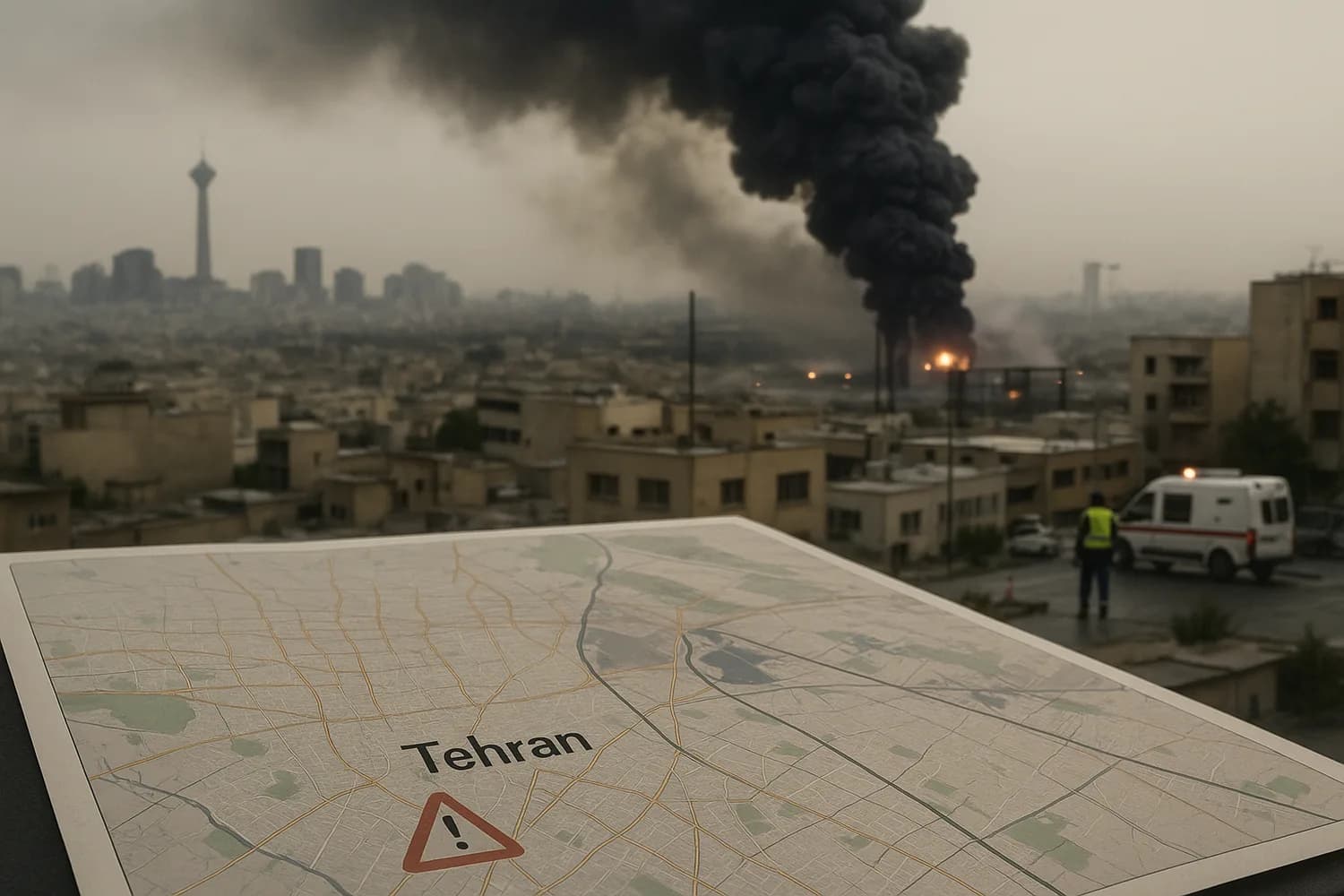
On March 8, 2026, reporting indicated Israeli strikes hit multiple fuel depots in and around Tehran, sending thick smoke over one of the Middle East's largest urban areas and prompting warnings about dangerous rain and degraded air quality. In a dense city, that is not only infrastructure damage. It is a mass-exposure event.
The public-health pathway is direct. WHO guidance on oil-fire chemical releases and WHO technical guidance on wartime technological hazards show that burning fuel infrastructure releases soot, sulfur dioxide, nitrogen oxides, volatile organic compounds such as benzene, and polycyclic aromatic hydrocarbons, meaning combustion pollutants that drive acute airway and cardiovascular stress and, if exposure is repeated, higher long-term disease risk.
The ecological pathway is equally important. Soot and oily residue settle on roofs, streets, trees, soil, and drains. In a drought-stressed city, that contamination is harder to wash out and easier to redistribute through runoff, dust, and direct contact. The Kuwait oil-fire record shows how hydrocarbon contamination can outlive the visible flames. Tehran adds a different danger: a much larger urban population under the plume from the start.
Initial severity grade is Severe, Regional. The long-run danger is not only chronic illness. It is political blowback. If civilians come to associate repeated smoke, dirty runoff, school disruption, and weakened urban services with a specific attacker, hostility hardens, compromise gets harder, and support for retaliation or prolonged resistance can rise. So what: continued fuel-site strikes would not just poison air. They would widen the war's civilian constituency.
2. Event Overview
On March 8, 2026, TIME reporting said Israeli strikes hit several fuel depots in Tehran, while Iranian state media reported that the Aghdasieh oil warehouse, an oil depot in Karaj, and Iran's main refinery in the south were among the targets. TIME also reported a Red Crescent warning that rainfall after the strikes could be dangerous and acidic. Those details should be treated as reported claims, not fully audited toxicology or industrial-damage measurements.
On March 9, 2026, Associated Press reporting said oil depots in Tehran were still smoldering. That matters because smoldering residue extends exposure beyond the initial blast and flame phase. A city can move from visible fire to lingering toxic load without looking calmer on the ground.
Tehran was already exposed to severe environmental stress before the strikes. In December 2024, Associated Press reporting described repeated shutdowns tied to severe air pollution and noted the city's geography traps dirty air. In November 2025, Associated Press reporting described drought and acute water stress in Tehran province. Smoke entering a polluted air basin and residue entering a water-stressed urban system creates a more dangerous exposure pattern than the same fire would in cleaner or wetter conditions.
- Actors: Israeli planners, Iranian emergency and health authorities, Tehran residents, hospitals, municipal cleanup teams, and urban ecosystems exposed to soot and runoff.
- Timeline: March 8 strikes and plume spread, followed by March 9 reports of continued smoldering.
- Confirmed vs developing: fires and smoke are confirmed; residue mapping, exposure measurements, and contamination pathways remain incomplete.
| Metric | Current baseline | Why it matters here |
|---|---|---|
| Population exposed | About 9.1 million residents in the city and about 14.5 million in the province, according to AP reporting from November 2025 | A fuel-site plume in Tehran reaches a very large civilian population quickly. |
| Air-trapping geography | The city is surrounded by hills and mountains on three sides, and stagnant air can trap emissions | Smoke can linger longer and spread across dense neighborhoods instead of dispersing quickly. |
| Baseline pollution burden | Authorities shut offices, universities, and schools over air pollution in December 2024 | The strike landed on a population already living with severe air-quality stress. |
| Water-system stress | Tehran entered a sixth consecutive year of drought in 2025, with some dams reported below 10% capacity | Residue and runoff are harder to manage safely when water systems are already under strain. |
| Core claim | Source | Type | Confidence contribution |
|---|---|---|---|
| Fuel depots in and around Tehran were hit and smoke spread over the city | TIME, Mar. 8, 2026; AP, Mar. 9, 2026 | Independent reporting | Moderate |
| Tehran's air basin and baseline pollution raise the danger of trapped smoke exposure | AP, Dec. 10, 2024 | Independent reporting | Moderate |
| Burning oil infrastructure creates acute health hazards and longer-tail contamination pathways | WHO oil-fire guidance; WHO wartime hazard guidance | Primary technical guidance | High |
| Protracted urban conflict causes cumulative public-health and service collapse effects | ICRC urban services report; ICRC indirect-effects report | Primary humanitarian analysis | High |
| Civilian harm can generate political blowback rather than pacification | NBER Afghanistan study; Oxford CSAE Ukraine study; Syrian refugees study | Peer-reviewed and working-paper analog evidence | Moderate |
2A. Background and Competing Explanations
Fuel depots are often framed as dual-use targets because civilian and military demand can run through the same storage and distribution systems. That explanation is plausible. It is also incomplete in a megacity, where the same strike predictably produces civilian smoke exposure and urban contamination.
One explanation is narrow military disruption: degrade fuel distribution linked to military mobility, backup power, and logistics. A falsifier would be a target pattern that stays tightly confined to clearly military-linked fuel nodes and avoids repeated attacks deeper into the civilian urban network.
A second explanation is coercive pressure: impose visible, citywide disruption without directly leveling dense residential blocks. A falsifier would be a one-off strike followed by clear restraint rather than recurring hits on depots, refineries, or chemical infrastructure.
A third explanation is signaling through fragility: show that prolonged war can make ordinary urban life toxic and unreliable. A falsifier would be no repeat targeting of infrastructure capable of generating plume, residue, or service failure.
The larger strategic issue is not the stated rationale alone. It is whether the attacker's operational gain outweighs the social and political costs of harming civilian air, water, and urban services. Analog evidence from Afghanistan, Ukraine, and refugee populations suggests visible civilian harm often hardens public attitudes against the force seen as responsible. So what: even when a target has military relevance, the blowback logic can still dominate the long run.
- Rule of thumb: in a dense city, the political effect of a fuel-site strike depends on who breathes the plume, who cleans the residue, and who gets blamed for the disruption.
- Related analysis: The Strait of Hormuz Is Already a Chemical and Industrial Shock, Not Just an Oil Story.
2B. Sources and Evidence
This article combines current event reporting with primary technical guidance and conflict analog research. The Tehran strike layer comes from March 2026 reporting. The public-health and ecological mechanisms come from WHO and ICRC materials plus Kuwait legacy studies. The blowback analysis comes from conflict research on civilian victimization and political response.
So what: the strongest current claim is that Tehran experienced a real urban toxic-exposure event. The long-tail contamination and blowback analysis is an evidence-based projection about what repeated attacks would likely do.
- 1. TIME report on Tehran fuel-depot strikes (news reporting, published 2026-03-08): describes the strikes, smoke, and reported Red Crescent warning.
- 2. Associated Press report on continued smoldering (news reporting, published 2026-03-09): confirms that Tehran oil depots were still smoldering the next day.
- 3. Associated Press report on Tehran air-pollution shutdowns (news reporting, published 2024-12-10): provides urban air-basin context.
- 4. Associated Press report on Tehran drought and water stress (news reporting, published 2025-11-07): provides context for stressed water and runoff systems.
- 5. WHO chemical-release guidance on oil fires (primary public-health guidance): identifies acute hazard pathways.
- 6. WHO technological-hazards guidance in war (primary technical guidance): explains why oil fires, residue, and runoff create longer-tail risk.
- 7. ICRC report on urban services during protracted armed conflict (primary humanitarian report, 2015): explains how attacks on urban systems create cumulative public-health and service consequences.
- 8. ICRC report on indirect effects of explosive weapons in populated areas (primary humanitarian report, 2024): explains reverberating effects from attacks on essential services and industrial infrastructure.
- 9. PubMed study on pulmonary toxicity from Kuwaiti oil-fire smoke particles (peer-reviewed study, 1998): supports the acute respiratory pathway from fine combustion particles.
- 10. PubMed study on persistent PAHs in Kuwait wildlife (peer-reviewed study, 2007): shows hydrocarbon contamination can persist in food webs long after the fires.
- 11. PubMed study on Kuwait oil-soil remediation (peer-reviewed study, 2023): shows contamination legacies can remain difficult and costly for decades.
- 12. NBER study on civilian casualties and insurgent violence in Afghanistan (working paper, 2010): links coalition-caused civilian casualties to more insurgent attacks.
- 13. Oxford CSAE working paper on civilian victimization in Ukraine (working paper, 2024): finds civilian victimization increased donations to the war effort.
- 14. Peer-reviewed study of Syrian refugees and support for peace after victimization (2023): shows civilian harm can also increase support for ending the war while hardening attitudes toward the attacker.
3. Threat Mechanism
The core mechanism is four-stage. First comes the plume. Burning fuel infrastructure releases fine particles and gases that move across the city quickly and concentrate in areas where dirty air is already trapped. Second comes deposition. Soot and oily residue settle on homes, roads, trees, soil, drains, and surface water.
Third comes service stress. Hospitals see more respiratory cases. Schools close. Municipal crews must wash streets, clear drains, and manage contaminated waste while still operating under wartime conditions. ICRC analysis of urban conflict shows that repeated cycles of damage and repair are where urban systems start to fail cumulatively rather than dramatically.
Fourth comes political hardening. A blast affects one radius. Smoke, residue, dirty runoff, and service disruption affect a much wider population. A concrete micro-example is a neighborhood with no direct building collapse but with black residue on balconies, children kept home from school, pets and birds exposed outdoors, and renewed fear about rainwater and tap water. That is how the harmed population expands beyond the original blast zone.
The Kuwait oil-fire record matters because it demonstrates persistence. Hydrocarbon fires can stop being visible long before they stop mattering. Tehran matters because population density turns a fuel strike into a far broader civilian event from the first day. So what: repeated fuel-site attacks in Tehran would predictably shift the war from direct destruction toward chronic urban attrition.
4. Risk Assessment
Near-term public-health harm is already likely because the city experienced fires, smoke spread, and next-day smoldering. The medium-term question is no longer whether exposure occurred. It is whether repeated attacks, slow cleanup, or contaminated runoff make the burden cumulative.
The impact range is wide because the same event reaches lungs, drains, schools, hospitals, trees, birds, pets, and political trust at once. In a dense capital, that makes the social radius of harm much larger than the physical radius of the fire.
If strikes continue against fuel and chemical sites, the probability of unrest and anti-attacker hardening rises with each cycle because more civilians will experience the war as a direct assault on the conditions of ordinary urban life. So what: the current event is acute. Repetition would make it strategic.
| Horizon | Probability estimate | Impact estimate | Confidence | Key driver |
|---|---|---|---|---|
| 0-2 years | 60-80% chance of significant acute health burden and wider civilian anger if strikes recur or smoldering persists | Respiratory stress, cardiovascular flare-ups, school disruption, distrust, and anti-attacker hardening | Moderate | Smoke duration, baseline pollution, and repeat targeting |
| 2-10 years | 35-55% chance of measurable chronic health, ecological, and political legacy if contamination is repeated or poorly remediated | Higher chronic disease burden, polluted soils and drains, urban biodiversity loss, harder-line public attitudes | Low-Moderate | Repeated attacks, weak monitoring, and slow cleanup |
| 10+ years | 20-40% chance that urban fuel targeting becomes a normalized coercive tactic in regional war | More fragile cities, higher civilian exposure baselines, deeper legitimacy damage in future conflicts | Low | Strategic success of indirect harm tactics |
5. Cascading and Second-Order Effects
The first cascade is medical. Tehran's existing pollution burden means the strike landed on a population already carrying respiratory stress. That increases the chance that a short smoke episode produces a wider hospital burden than raw burn duration alone would suggest.
The second cascade is ecological. The likely near-term pattern is not cinematic wildlife collapse. It is dirtier soil, contaminated drains, harmed vegetation, exposed birds and insects, and repeated contact between residue and urban animals. Kuwait analog studies show that food-web contamination can persist well beyond the visible fire phase.
The third cascade is civic. ICRC work on indirect effects shows that attacks in populated areas often produce wider harm through essential services and infrastructure interdependence. A concrete micro-example is residue entering drainage systems during rainfall, forcing cleanup burdens, street-level exposure, and renewed anxiety about water safety even in places not directly hit.
The fourth cascade is political. Analog evidence from Afghanistan and Ukraine suggests civilian victimization can increase support for continued resistance, donations, or hostility toward the attacker. Evidence from Syrian refugees shows another pathway: more support for peace, but not forgiveness. Both directions are bad for the attacker if the goal is durable coercion with limited social blowback. So what: ecological damage broadens the affected population, and a broader affected population usually means stronger political consequences.
- Health systems: repeated smoke episodes can crowd hospitals and delay routine care.
- Urban services: drainage, street cleaning, and waste handling become part of wartime resilience.
- Nature and wildlife: the main danger is chronic residue and runoff exposure, not only visible fire damage.
- Unrest and anger: diffuse civilian harm can widen anti-attacker sentiment well beyond directly injured families.
- Reconciliation risk: repeated ecological harm makes later diplomatic reset and social de-escalation harder.
6. Countervailing Forces
Not every depot fire becomes a long contamination disaster. WHO guidance notes that fuel depots may extinguish faster than oil-well fires. That lowers cumulative dose if containment is quick and if residue is removed before it is redistributed.
Rapid monitoring, targeted shelter guidance, runoff control, and residue removal can materially reduce long-tail harm. Political blowback is also not mechanically identical across wars. Some populations become more supportive of retaliation, others more desperate for an end to the fighting, and many can hold both attitudes at once.
But those limits do not remove the core pattern. In a dense city, repeated fuel-site strikes predictably widen civilian exposure and widen blame attribution. So what: mitigation can shrink the tail, but repetition recreates it.
- Duration factor: shorter fires mean lower cumulative dose.
- Cleanup factor: early residue removal can sharply reduce soil and runoff exposure.
- Political variation: blowback can express as unrest, hardening, mobilization, or stronger demand for peace.
7. Global Future Implications
If fuel depots inside major cities become regular targets, urban warfare changes in a way that is easy to underestimate. Civilian harm no longer depends mainly on direct blast deaths. It also depends on how often a city is forced to breathe, wash, and live through hydrocarbon contamination.
A concrete micro-example is a district that never sees a collapsed tower block but still accumulates war damage through repeated smoke inhalation, dirty balconies, anxious parents, stressed clinics, and contaminated drains. That is politically potent because it is intimate, repeated, and widely shared.
The long-run strategic implication is a legitimacy trap. An attacker may damage fuel logistics in the short term while simultaneously creating a larger population that feels attacked personally and environmentally. That population can become more hostile, more mobilized, harder to pacify, and less open to compromise.
So what: the importance of the Tehran depot strikes is not only toxic smoke. It is the precedent that ecological damage inside a capital can function as a force multiplier for long-war resentment.
8. Threat Grade
This grade reflects a confirmed urban smoke event with credible pathways into chronic illness, ecological persistence, and anti-attacker blowback if strikes continue. It does not assume that the worst long-term outcomes are already locked in.
So what: the decisive variable is repetition. One event is a public-health shock. A series of events becomes a political and ecological strategy.
- Impact: 4/5. Fuel-site strikes in a megacity can expose millions, degrade urban ecology, and widen hostility toward the attacker.
- Probability: 4/5. Acute harm is already plausible, and repeated strikes would likely intensify both health and blowback effects.
- Composite: 16/25 using Impact x Probability. Category: Severe. Scope: Regional.
9. Uncertainty and Confidence
The biggest analytical mistake would be to reduce this story to either a one-day fire or a guaranteed long-term disaster. The more accurate frame is cumulative risk. Each additional strike, each delayed cleanup cycle, and each new exposure episode pushes the city further from shock and deeper into attrition.
| Scenario | Trigger | Near-term outcome | Threat-grade direction |
|---|---|---|---|
| Contained smoke event | Fires extinguished quickly and residue removed fast | Acute exposure burden, limited ecological tail, manageable political aftershock | Down |
| Repeated urban fuel targeting | Additional strikes on depots, refinery-linked assets, or chemical infrastructure | Cumulative smoke, broader contamination, and wider civilian anger | Up |
| Urban attrition cycle | Recurring strikes plus weak monitoring, slow cleanup, and stressed services | Long-tail health damage, ecological persistence, unrest, and hardened anti-attacker sentiment | Up sharply |