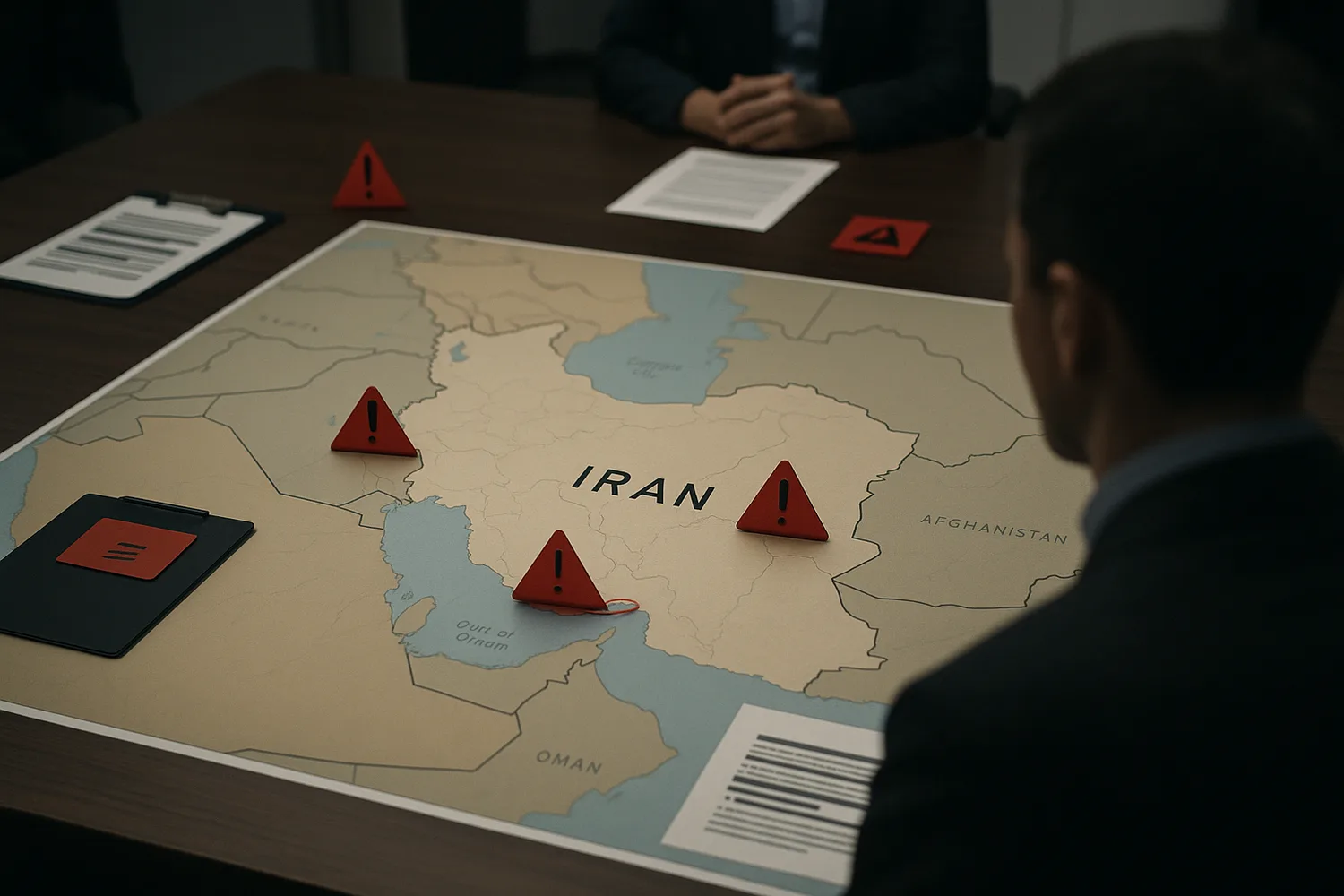
1. Executive Summary
On March 9, 2026, the International Monetary Fund said traffic through the Strait of Hormuz had fallen about 90 percent after Israeli and U.S. strikes on Iran and the regional response. For energy and trade systems, that is already a closure event even if governments avoid the cleaner legal phrase. The corridor is functioning far below normal and cargo decisions are being made as if passage is exceptional rather than routine.
The visible headline is oil. The deeper mechanism is industrial interruption. Hormuz is also a route for liquefied natural gas, liquefied petroleum gas, naphtha, methanol, sulfur, lubricants, fertilizers, containers, and time-sensitive cargo moving through Gulf hubs. When that channel contracts abruptly, the shock propagates from energy into chemicals, manufacturing, food systems, and medical supply chains.
Initial severity grade is Severe, Global. The most probable harm is not a single price spike. It is a stop-start logistics regime in which insurers, crews, ports, and carriers repeatedly act defensively, forcing rerouting, higher working-capital costs, plant slowdowns, and delayed deliveries even before formal blockade conditions exist.
Key uncertainties include whether the current effective closure persists across multiple insurance and carrier decision cycles, whether escorted or voyage-specific traffic resumes, and which industrial chains deplete inventories first. So what: for supply chains, the question is no longer whether Hormuz might close. It is how long this already-abnormal state lasts.
2. Event Overview
The sequence is now clearer than it was a few days ago. After the late-February strikes in Iran and the subsequent escalation, Associated Press reporting described oil-tanker traffic through Hormuz grinding to a halt. On March 2, MSC issued an end-of-voyage notice and Maersk tightened booking acceptance and special-cargo restrictions.
By March 2, the ITF and Joint Negotiating Group designated the Strait of Hormuz a high-risk area, changing crew-rights and labor-risk calculations. By March 5, the Joint Maritime Information Center published a vessel-transit comparison showing steeply reduced passage. By March 6, Maersk suspended services to the United Arab Emirates, Qatar, and Bahrain. By March 9, the IMF said traffic was down about 90 percent.
| Core claim | Source | Type | Confidence contribution |
|---|---|---|---|
| Traffic through the Strait of Hormuz fell about 90 percent by March 9, 2026 | IMF remarks, Mar. 9, 2026 | Primary public remarks | High |
| Shipping lines imposed booking limits, end-of-voyage clauses, and service suspensions | MSC and Maersk notices, Mar. 2-6, 2026 | Primary operational notices | High |
| Crew-risk rules changed, increasing the chance that willing tonnage becomes the constraint | ITF-JNG designation, Mar. 2, 2026 | Primary labor and risk notice | Moderate-High |
| The disruption extends beyond oil into wider traded goods and industrial inputs | AP, UNCTAD, ICIS, Argus | Independent reporting plus primary data | Moderate |
2A. Background and Competing Explanations
A closure event in Hormuz does not need a clean legal announcement. One explanation is deliberate coercion, where Iran or other actors raise risk until passage becomes commercially exceptional. A second is market self-closure, where owners, insurers, and carriers suspend movement because one successful attack would be intolerably costly. A third is temporary military signaling, where traffic collapses sharply but rebounds once forces step back. A fourth is logistics self-protection, where networks pause first because uncertainty itself is enough to break schedules.
Incentive check: Iran has incentives to maximize leverage without necessarily inviting a total naval war. Shipowners, insurers, and liner operators have incentives to suspend early because their downside is asymmetric. Gulf exporters have incentives to describe the disruption as temporary to prevent customer flight and panic buying.
Discriminators still matter. A hard state-imposed closure should correlate with repeated interdiction and long-duration naval contestation. A market-driven closure should correlate with faster recovery once cover, crew consent, and port acceptance return. A broader industrial shock should correlate with continuing restrictions on chemicals, reefer cargo, dangerous goods, and Gulf transshipment even if some crude sailings resume.
2B. Sources and Evidence
This source set leans heavily on current primary material because the question is operational rather than interpretive. Company notices, labor designations, maritime monitoring, IMF remarks, and energy baseline data establish that the strait is already functioning in an abnormal state. Independent reporting and specialist commodity coverage help show which downstream sectors are beginning to feel it.
So what: the strongest claims in this article are about active commercial disruption and baseline chokepoint dependence. The weakest claims are detailed plant-level shortage estimates, which should still be treated as early indicators.
- 1. IMF Managing Director remarks at the Kiel Institute Global Economic Symposium (primary speech, published 2026-03-09): says traffic through the Strait of Hormuz fell about 90 percent and reiterates its role in global oil and LNG trade.
- 2. Joint Maritime Information Center update (primary maritime monitoring, reviewed 2026-03-09): provides vessel-transit comparison showing the sharp contraction in traffic since late February.
- 3. ITF-JNG high-risk-area designation (primary labor and shipping-risk notice, published 2026-03-02): changes crew-risk rules for Hormuz transits.
- 4. MSC end-of-voyage declaration for the Arabian Gulf and MSC war-risk surcharge notice (primary carrier notices, published 2026-03-02 and 2026-03-03): show how carriers are changing cargo handling and cost allocation.
- 5. Maersk booking and special-cargo restrictions and Maersk suspension notice (primary logistics notices, published 2026-03-02 and 2026-03-06): confirm abnormal operating conditions across Gulf services.
- 6. Gard war-risk cancellation circular and Gard shipping-risk analysis (primary insurance documents, reviewed 2026-03-09): show how war cover can narrow geographically and raise commercial friction.
- 7. Associated Press report on supply-chain disruption from the Iran war and Associated Press explainer on the Strait of Hormuz (news reporting, published 2026-03-04 and 2026-03-02): document goods exposure beyond crude oil.
- 8. U.S. Energy Information Administration Hormuz oil and LNG analyses and LNG transit note (primary energy analysis, published 2025-06-24 and 2025-06-16): quantify baseline dependence and bypass constraints.
- 9. UNCTAD Review of Maritime Transport 2025 (primary maritime report, published 2025-10-22): shows the strait's role in wider maritime trade, not only energy.
- 10. ICIS report on regional petrochemical output shrinking and ICIS report on methanol vessel disruption plus Argus reporting on sulfur supply risk (industry reporting, published 2026-03-04 to 2026-03-06): indicate how the closure is reaching chemicals and metals processing.
3. Threat Mechanism
The main harm pathway runs through molecules and schedules, not only barrels. Hormuz carries crude and LNG, but it also sits on the route for liquefied petroleum gas, naphtha, methanol, sulfur, base oils, fertilizers, containers, and time-sensitive cargo moving through Gulf hubs. When the channel contracts sharply, the first-order shock is energy pricing and the second-order shock is industrial sequencing.
A concrete micro-example is naphtha. If Gulf naphtha cargoes are delayed, Asian steam crackers cut operating rates. Lower cracker output then reduces ethylene and propylene availability, tightening packaging film, auto parts, appliance housings, and medical disposables. The oil headline appears first, but the plastics shortage can emerge later and linger longer.
A second micro-example is methanol and sulfur. ICIS reported methanol vessel disruption and emergency petrochemical stops, while Argus reported sulfur supply risk feeding into Indonesian nickel intermediate economics. That is how a chokepoint shock jumps from shipping into solvents, resins, fertilizers, battery materials, and metals processing.
A third micro-example is container and reefer cargo. Maersk restrictions and MSC end-of-voyage handling mean food, drugs, and industrial inputs can be discharged short of destination or delayed at transshipment points even when they are not dangerous cargoes themselves.
- Energy molecules: crude, condensate, LNG, and liquefied petroleum gas
- Chemical feedstocks: naphtha and methanol
- Industrial inputs: sulfur, base oils, polymers, and fertilizers
- Logistics channels: containers, reefer cargo, dangerous goods, and Gulf transshipment services
4. Risk Assessment
Near-term probability is high because the abnormal operating state is already visible and because commercial actors often restore service more slowly than they suspend it. Insurers, liner operators, and plant schedulers do not need a formal closure decree to keep acting defensively.
Impact is high because the strait sits across multiple upstream nodes at once. A sustained disruption in Hormuz can hit energy, fertilizer, plastics, lubricants, metals processing, and time-sensitive trade in parallel, increasing the odds of inflation, shortages, and synchronized production cuts.
So what: the relevant benchmark is no longer normal traffic. It is how long the system remains far below normal traffic.
| Horizon | Probability estimate | Impact estimate | Confidence | Key driver |
|---|---|---|---|---|
| 0-2 years | 65-85% chance of recurrent effective-closure episodes or a multi-week stop-start disruption in the current crisis | Oil and LNG spike, chemical-input shortages, freight shock, and inventory drawdown | Moderate | Naval risk, insurer withdrawal, crew constraints, and carrier suspensions |
| 2-10 years | 40-60% chance the Hormuz risk premium becomes a structural feature of Gulf trade | Higher fertilizer, plastics, and shipping costs; more fragmented supply chains | Low-Moderate | Repeated crises, strategic stockpiling, and rerouting investment |
| 10+ years | 25-45% chance chokepoint coercion becomes normalized in regional conflict planning | Lower trade efficiency, chronic resilience spending, and weaker global integration | Low | Success of closure-like tactics without decisive reversal |
5. Cascading and Second-Order Effects
Second-order effects spread through timing, contracts, and inventory. Importers can manage a short spike if ships keep moving. They struggle when rerouting, surcharge resets, end-of-voyage declarations, and delayed handoffs recur across multiple sailings.
A concrete micro-example is pharmaceuticals and manufactured goods. Associated Press reporting described exposure for drugs, electronics, tires, apparel, and machinery routed through or dependent on the region. The issue is not that everything stops on day one. It is that components, packaging, reefer slots, and delivery calendars all become less reliable at once.
Another second-order effect is labor. High-risk-area designation changes seafarer rights and can reduce willing tonnage even if some hulls remain technically available. That hidden capacity loss matters because closure can persist through crew and insurance frictions after the immediate military trigger changes.
A third second-order effect is financial. Working capital rises when importers must hold more buffer stock, absorb surcharge volatility, and finance longer routings. Smaller firms feel this earlier than governments or large commodity houses. So what: the industrial damage from Hormuz is governed by contracts and cycles as much as by missiles.
- Energy: oil and LNG shocks feed inflation and reserve-management pressure.
- Chemicals: naphtha, methanol, sulfur, and polymers transmit stress into plastics, fertilizer, and metals chains.
- Trade logistics: reefer and dangerous-goods restrictions spread disruption beyond tankers.
- Labor and insurance: crew rights and war-risk repricing can keep traffic subnormal after the first shock.
6. Countervailing Forces
A long-lived hard military closure of Hormuz remains difficult to sustain. The current event shows that a corridor can become commercially closure-like well before it becomes perfectly sealed. That distinction matters because reopening can also happen in stages rather than all at once.
Bypass pipelines and alternative routings exist, but they do not replace normal Hormuz throughput. They help at the margin, especially for some crude volumes, while leaving LNG, containerized trade, and many specialized cargoes more exposed.
Commercial actors can also reopen unevenly. Voyage-specific cover may return before annual conditions normalize. Strategically important cargoes may move under escort or special terms before liner networks and lower-margin cargoes feel safe enough to return. So what: the most likely stabilizer is partial reopening under abnormal cost, not an instant return to normal.
- Naval restoration factor: major powers and Gulf states have strong incentives to reopen some traffic.
- Bypass factor: pipelines mitigate a portion of lost crude flows, but not LNG and many specialized cargoes.
- Inventory factor: some importers can smooth short disruptions through stockpiles and supplier substitution.
7. Global Future Implications
If Hormuz can be pushed into closure-like conditions this quickly, the strategic lesson is not only about the Gulf. It is about how modern trade chokepoints fail in practice. Commercial actors can turn a narrow maritime corridor into a systems shock before a formal blockade is cleanly declared.
A concrete micro-example is the combined effect of insurer repricing, crew-risk designation, end-of-voyage cargo handling, and carrier suspension. None of those steps alone is the closure. Together they create one that is economically real even when the legal framing remains ambiguous.
Long-run, repeated Hormuz shocks would encourage more inventory, more regionalization, more strategic stockpiling, and more pressure for supply-chain duplication in chemicals, fertilizers, and critical manufacturing inputs. Those choices improve resilience for some states while raising structural costs for everyone.
So what: the wider lesson is that commercial closure can be as strategically consequential as a formal naval blockade.
8. Threat Grade
This grade reflects an active disruption that has already crossed from hypothetical closure analysis into live industrial monitoring. It does not assume a permanent legal blockade or universal immediate shortages in every sector.
So what: the core issue is that closure conditions are already visible in trade behavior.
- Impact: 5/5. Hormuz connects energy, chemicals, fertilizer, containers, and industrial inputs at a scale large enough to move global inflation and production.
- Probability: 4/5. The corridor is already operating far below normal and the chance of continued disruption is high.
- Composite: 20/25 using Impact x Probability. Category: Severe. Scope: Global.
9. Uncertainty and Confidence
The biggest analytical mistake would be to treat the current event as either full normality or a clean permanent blockade. The system is operating in between those states, and that in-between condition is where contracts, plants, and inventories take damage.
| Scenario | Trigger | Near-term outcome | Threat-grade direction |
|---|---|---|---|
| Fast reopening | Voyage-specific cover returns and Gulf services resume within days | Oil shock fades and industrial damage stays limited | Down |
| Stop-start closure | Escorted traffic returns unevenly while carriers and crews remain cautious | Persistent surcharges, rerouting, and selective shortages | Flat to up |
| Broader industrial shock | Chemical feedstock and container restrictions outlast the first energy spike | Production cuts, inflation pressure, and wider goods disruption | Up |
| Hard interdiction | Repeated attacks or mining keep traffic near current lows | Severe global energy and trade shock with direct naval confrontation risk | Up sharply |