1. Executive Summary
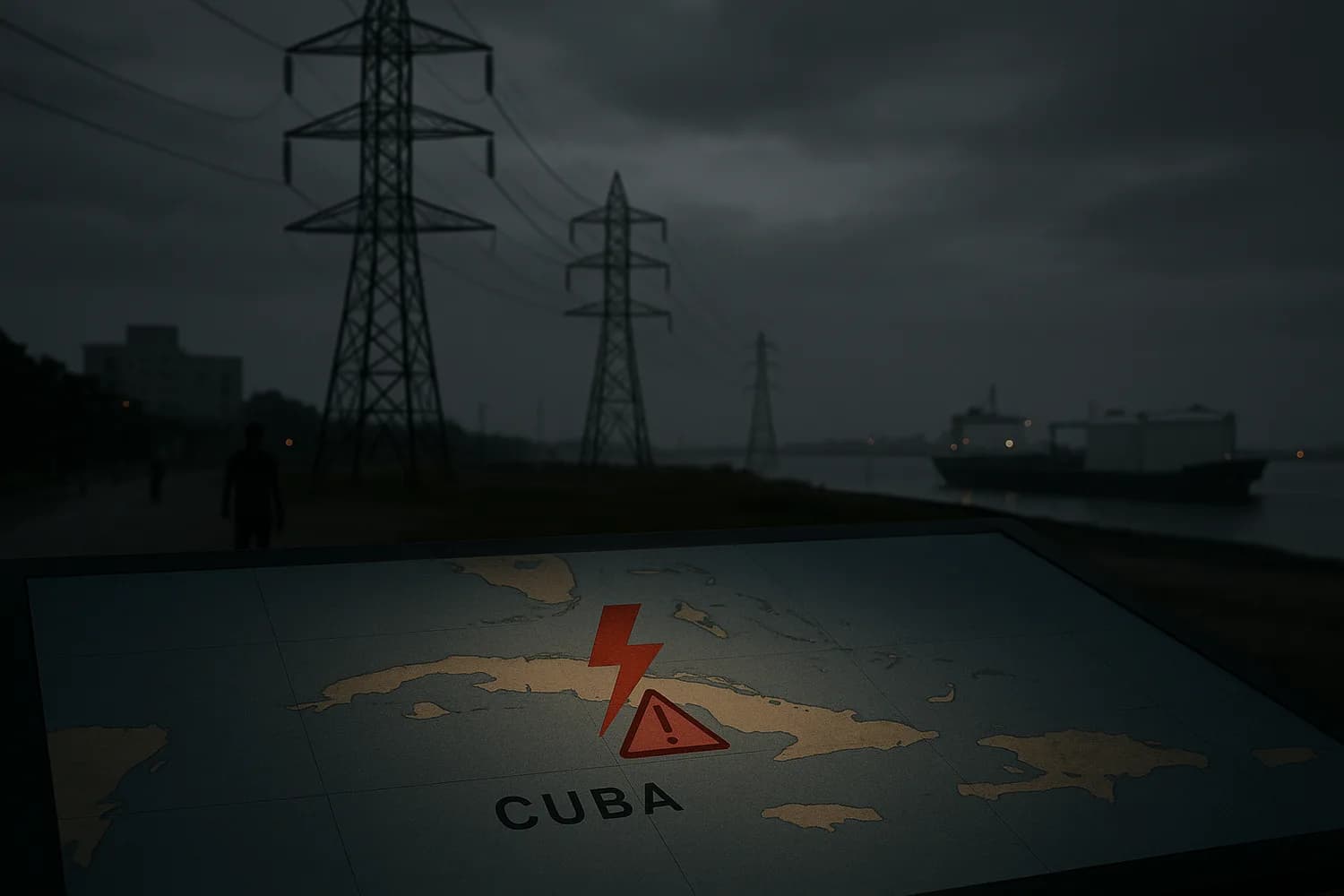
On March 4, 2026, the shutdown of the Antonio Guiteras thermoelectric plant triggered a major blackout across western Cuba. By March 7, Associated Press reporting said only 1,000 megawatts were available, less than half current demand. That is not a normal maintenance problem. It is a sign that Cuba's reserve margin is too thin to absorb a single large failure.
The energy crisis now reaches directly into health and basic services. A March 6 Pan American Health Organization situation report says electricity outages are affecting cold-chain systems and health services, while more than 80 percent of pumping systems depend on electricity. Cold chain means the refrigerated storage and transport system used to keep food and medicines safe.
Initial severity grade is Severe, Regional. The main analytical error is to treat this as only a U.S. embargo story or only a maintenance story. The embargo and recent oil-supply pressure are major external multipliers. But repeated plant trips and weak redundancy also point to domestic underinvestment and an aging grid. The most likely near-term danger is repeated cross-sector failure: blackouts that weaken water access, sanitation, transport, clinics, food storage, and tourism earnings together.
Key uncertainties include whether emergency fuel access can stabilize generation before the next storm season, whether contingency measures can protect hospitals and water systems, and whether continued emigration further reduces technical and medical staffing. So what: Cuba is facing a multi-system fragility loop, not an isolated outage.
2. Event Overview
The immediate trigger was the March 4 shutdown of the Antonio Guiteras plant. Associated Press reporting said the blackout left swaths of western Cuba without power and required priority restoration for hospitals and water stations. Two days later, the same report said officials expected repairs to take several days.
The problem is broader than one plant. On March 7, Associated Press reporting said available generation was still less than half current demand. On March 4, a separate Associated Press report on Air France suspensions showed fuel scarcity had already spread into airport operations and tourism revenue.
The external supply backdrop also tightened before the blackout. On January 29, 2026, the White House executive order on Cuba created a tariff mechanism against countries that directly or indirectly provide oil to Cuba. That did not create the aging grid. It likely did make fuel access riskier and more expensive.
- Timeline: Jan. 29 White House order targeting countries that provide oil to Cuba, Feb. 16 fuel queues and rationing pressure, March 2 emergency policy rhetoric, March 4 blackout, March 7 still-severe generation shortfall.
- Actors: state utilities, hospitals, municipal services, households, transport operators, airlines, and humanitarian agencies.
- Confirmed vs developing: the service disruption is real; the duration and full social cost remain uncertain.
| Core claim | Source | Type | Confidence contribution |
|---|---|---|---|
| A single thermoelectric failure caused a major blackout across western Cuba | AP, Mar. 5, 2026 | Independent reporting | High |
| Available generation remained below half of demand after repairs began | AP, Mar. 7, 2026 | Independent reporting | High |
| Electricity outages are affecting cold chain and health services, and over 80 percent of pumping systems depend on electricity | PAHO, Mar. 6, 2026 | Primary humanitarian situation report | High |
| Health facilities lose core functions when reliable electricity is absent | WHO fact sheet on electricity in health care facilities | Primary technical guidance | High |
| Fuel shortages are spilling into airport operations and tourism earnings | AP, Mar. 4, 2026 | Independent reporting | Moderate |
| The U.S. embargo remains broad, but some licensed trade still continues | USTR Cuba trade summary, 2026 | Primary official trade summary | High |
| A January 29 White House order targeted countries supplying oil to Cuba | White House executive order, Jan. 29, 2026 | Primary policy document | High |
2A. Background and Competing Explanations
A reasonable reader question is whether this is basically a U.S. embargo story. The answer is partly yes and not fully. The embargo is a major external constraint, but the March blackout pattern also reflects old plants, low redundancy, and years of thin maintenance margin.
The external-pressure case is strong. USTR's Cuba trade summary says the U.S. trade embargo remains in place and most transactions between the United States and Cuba continue to be prohibited. On January 29, 2026, the White House executive order on Cuba created a tariff mechanism against countries that directly or indirectly provide oil to Cuba. That kind of policy can tighten shipping, insurance, credit, and intermediary willingness even before any specific cargo is blocked.
But the embargo is not a total commercial seal. USTR says U.S. goods exports to Cuba reached $810.8 million in 2025. OFAC's TSRA program guidance continues to authorize licensed exports of agricultural commodities, medicine, and medical devices to Cuba. That matters because it rules out the simplest story. Cuba is constrained hard, not hermetically cut off.
The internal-fragility case is also strong. If fuel availability improves but large thermoelectric units keep tripping, the core problem is not only access to imported fuel. It is an aging fleet with too little redundancy, weak maintenance buffers, and limited distributed backup. A single-plant failure should not black out such a large share of the system if reserve margin is healthy.
A third explanation is crisis triage. Associated Press reporting described fuel-saving measures, long waits for gasoline, and restrictions severe enough to push classes online and cut some public transport. If essential services stabilize while civilian mobility keeps shrinking, rationing may be buying time rather than restoring resilience.
Incentive check matters. Cuban authorities have incentives to emphasize external pressure when explaining hardship. U.S. policymakers have incentives to present fuel pressure as leverage. Airlines and humanitarian agencies have incentives to foreground operational disruption because their own systems are directly affected by it. None of that proves bad faith. It does mean narrative incentives are not identical to causal certainty.
2B. Sources and Evidence
This article combines current event reporting, a primary regional humanitarian assessment, primary technical guidance on electricity-dependent health care, and official U.S. policy and trade documents on Cuba sanctions and licensed exports. The strongest confirmed claims are the blackout itself, the post-repair generation shortfall, the documented effects on health services and pumping systems, and the fact that the embargo remains broad rather than total.
The more interpretive layer is about how those failures propagate into governance stress, migration pressure, and long-run recovery capacity. That layer is evidence-based but still a projection rather than a confirmed outcome. So what: the direct service shock and the sanctions-constrained fuel environment are well supported. The medium-term institutional damage is the main analytical judgment.
- 1. Associated Press report on the March 5 blackout and priority restoration (news reporting, published 2026-03-05): confirms blackout scope, fragile-grid framing, and priority restoration for hospitals and water stations.
- 2. Associated Press report on the March 7 post-blackout generation shortfall (news reporting, published 2026-03-07): says only 1,000 megawatts were available, less than half current demand.
- 3. PAHO Cuba situation report (primary humanitarian situation report, updated 2026-03-06): documents effects on health services, cold chain, water pumping, transport, sanitation, and migration context.
- 4. WHO fact sheet on electricity in health care facilities (primary technical guidance, published 2023-08-31): explains why unreliable electricity degrades clinical care, oxygen supply, lighting, sterilization, and vaccine storage.
- 5. Associated Press report on Air France suspending Havana flights (news reporting, published 2026-03-04): shows fuel scarcity spilling into airport operations and tourism revenue.
- 6. Associated Press report on fuel queues and ration appointments (news reporting, published 2026-02-16): shows fuel scarcity is systemic, not confined to one plant or one city.
- 7. Associated Press report on urgent economic changes amid dwindling oil reserves (news reporting, published 2026-03-02): provides policy context and the government's own framing of the fuel emergency.
- 8. White House executive order on Cuba (primary policy document, published 2026-01-29): establishes a national emergency and a tariff mechanism targeting countries that directly or indirectly provide oil to Cuba.
- 9. USTR Cuba trade summary (official trade summary, published 2026): says the embargo remains in place and most transactions continue to be prohibited, while U.S. goods exports to Cuba reached $810.8 million in 2025.
- 10. OFAC TSRA program guidance (primary licensing guidance, accessed 2026-03-09): explains licensed exports of agricultural commodities, medicine, and medical devices to Cuba.
3. Threat Mechanism
The failure pathway starts with low slack. Cuba's grid depends on a small number of large thermal plants plus imported fuel. When one major plant trips, the system cannot easily reroute enough power or ramp enough backup generation to preserve normal service. Sanctions and oil-supply pressure do not cause a turbine failure directly, but they can make fuel, shipping, financing, and spare-parts access slower and more expensive. In a system with almost no reserve margin, those frictions matter.
From there the shock spreads through electricity dependence. The PAHO situation report says more than 80 percent of pumping systems depend on electricity and 70 percent of households rely on electric cooking. A concrete micro-example is a neighborhood that loses power, then loses pumped water, then shifts to tanker delivery or unsafe storage. The outage has become a sanitation problem before it is fixed as an energy problem.
Health services are the next bottleneck. WHO guidance on electricity in health care facilities shows that unreliable power can disable lighting, sterilization, oxygen support, refrigeration, and basic diagnostics. PAHO says Cuba's outages are already affecting cold-chain systems and health services. That means the emergency is moving through clinical infrastructure, not only household comfort.
So what: the grid problem becomes a governance problem because basic services fail through the same dependency chain.
4. Risk Assessment
The near-term risk is repeated cross-sector disruption, not a single dramatic collapse. Cuba can keep some essential systems running through prioritization, but that does not prevent accumulated damage to public health, sanitation, transport, and household resilience.
The medium-term risk is institutional thinning. If outages, fuel scarcity, and migration continue together, each round of stress leaves fewer skilled workers, weaker maintenance capacity, and a lower ability to absorb the next failure.
So what: the highest-probability outcome is chronic deterioration with periodic acute shocks, not a one-time terminal break.
| Horizon | Probability estimate | Impact estimate | Confidence | Key driver |
|---|---|---|---|---|
| 0-2 years | 55-75% chance of repeated blackout-driven service failures | Hospital strain, intermittent water supply, sanitation disruption, food spoilage, and tourism cash losses | Moderate | Fuel access, plant reliability, and storm exposure |
| 2-10 years | 40-65% chance of deeper service erosion and faster outward migration if the grid is not materially renewed | Lower state capacity, weaker maintenance, chronic humanitarian dependence, and broader regional migration pressure | Low-Moderate | Underinvestment, emigration of skilled labor, and recurring fuel scarcity |
| 10+ years | 25-45% chance of a locked-in low-reliability infrastructure trap | Recurring national emergencies with wider regional spillovers during hurricanes, disease outbreaks, or supply shocks | Low | Whether Cuba diversifies generation and restores system redundancy |
5. Cascading and Second-Order Effects
The first cascade is public health. When outages affect cold storage, clinics, and pumping systems together, the burden is not only delayed comfort. It is delayed treatment, weaker infection control, and lower water reliability. A concrete micro-example is a clinic with generator priority but a surrounding community with intermittent water and food refrigeration. Clinical continuity exists on paper, while everyday health conditions keep deteriorating outside the facility.
The second cascade is sanitation and municipal order. PAHO says environmental sanitation, waste management, and rodent control efforts have been affected by fuel shortages and transport disruption. That matters because sanitation failures amplify other risks. They turn a power emergency into a disease and livability emergency.
The third cascade is economic and external. Associated Press reporting on Air France said flights from Paris to Havana will be suspended for weeks because of fuel shortages. A concrete micro-example is a flight that must refuel in the Bahamas on the return leg. That is a direct signal that Cuba's fuel crisis is now damaging hard-currency earning channels.
The fourth cascade is migration and governance. PAHO says roughly 10 percent of Cuba's population left during 2022 and 2023, and that by January 2026 there were 349,971 Cuban asylum-seekers and 23,944 refugees globally. Energy unreliability does not explain that movement alone, but it can deepen the logic for leaving and reduce the state's technical capacity as more people depart. So what: the secondary effects may be more consequential than the blackout itself.
- Health systems: outages and fuel scarcity can degrade both acute care and routine prevention.
- Water and sanitation: electric pumping dependence turns grid failure into a hygiene and waste-management risk.
- Food systems: weak refrigeration increases spoilage and undermines household coping capacity.
- Tourism and hard currency: flight suspensions and refueling detours hit one of Cuba's few major cash inflow channels.
- Migration: service unreliability can intensify outward movement and drain technical labor.
6. Countervailing Forces
Cuba still has some resilience. Priority restoration for hospitals and water stations, along with existing public-health infrastructure, can reduce the immediate human cost of outages. Even in the March blackout, Associated Press reporting said power had returned to 30 hospitals and 10 water supply stations while broader restoration continued.
The state is also actively triaging demand. Associated Press reporting on fuel scarcity and on March 2 policy changes says public transportation has been cut in some areas, classes have moved online, and emergency fuel-saving measures remain in force. Those actions are costly, but they can slow a faster cascade.
Not every external channel is fully closed. USTR's Cuba trade summary says U.S. goods exports to Cuba reached $810.8 million in 2025, while the embargo remained in place and most transactions stayed prohibited. OFAC's TSRA guidance continues to permit licensed exports of agricultural commodities, medicine, and medical devices. That does not solve the fuel problem. It does show Cuba is operating under severe constraints rather than a total trade blockade.
So what: mitigations can reduce immediate harm, but they do not remove the structural problem of low redundancy and high fuel dependence.
7. Global Future Implications
Cuba is a compact warning about compound fragility in import-dependent states. Fuel access, aging infrastructure, climate exposure, and outward migration are often analyzed separately. In practice they reinforce one another.
A concrete micro-example is a future hurricane striking while fuel reserves are low and the thermal fleet is already unstable. The storm would not need to destroy the whole grid to create a much larger crisis. It would only need to knock out enough damaged infrastructure that water pumping, cold chain, clinics, and transport fail together for longer than planned.
For the wider region, the main implication is governance stress with migration spillover. Repeated service unreliability in vulnerable states can push more people outward, increase humanitarian monitoring burdens, and weaken trust that public institutions can still guarantee basic continuity.
The long-run issue is reversibility. Grid reliability can be rebuilt with fuel access, generation renewal, and storage or distributed power. But if technical workers and medical staff keep leaving, recovery becomes slower even when money or fuel arrives. So what: the danger is not only today's blackout. It is a lower-energy, lower-capacity equilibrium that becomes harder to reverse over time.
8. Threat Grade
This grade reflects a confirmed cross-sector service emergency with credible pathways into public health, sanitation, migration pressure, and weaker state capacity. It does not assume imminent regime collapse or irreversible failure.
So what: Cuba's risk is severe because multiple essential systems are now failing through the same energy bottleneck.
- Impact: 4 out of 5. The crisis can simultaneously hit hospitals, water systems, sanitation, transport, tourism revenue, and migration dynamics.
- Probability: 4 out of 5. Repeated outages and fuel scarcity are already happening, and the structural drivers remain in place.
- Composite: 16 out of 25 using Impact x Probability. Category: Severe. Scope: Regional.
9. Uncertainty and Confidence
Scenario comparison matters because the same outage pattern can either stabilize through emergency fuel and repairs or compound through another plant failure or storm. So what: the threat grade should rise if another major plant trip lands before reserves recover, and it should fall if fuel inflows and critical-service reliability improve together.
| Scenario | Trigger | Near-term outcome | Risk to watch |
|---|---|---|---|
| Stabilization | Fuel inflows improve and repaired plants hold steady | Blackouts ease, hospitals and pumping systems regain margin, and migration pressure grows more slowly | Whether available generation rises above demand with some reserve left |
| Managed scarcity | Rationing continues but major plants mostly stay online | Essential services keep functioning unevenly while transport, tourism, and households absorb more pain | How long triage measures remain in place without broader renewal |
| Compounding failure | Another major plant trip or storm hits before reserves recover | Water, sanitation, and health-service stress deepen sharply and outward migration incentives increase | Duration of outage plus dependence on emergency workarounds |